Views: 48
都立高校でIB(国際バカロレア)コースを持つ国際高校
Tokyo Metropolitan Kokusai High School offers an IB (International Baccalaureate) program.
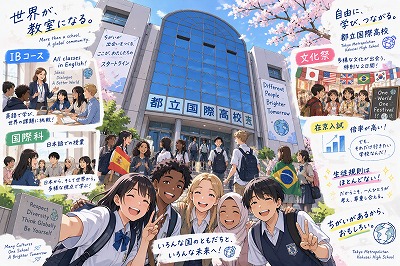 在京特別入試を目指す外国人のなかで、人気な学校はやはり、国際高校でしょう。
Among foregin students aiming to take the special entrance exams for schools in Tokyo, Kokusai High School is probably the most popular choice.
一般入試では国際科があり、そのほかにIB(国際バカロレアコース)入試、帰国生徒対象入試があり、在京入試があります。
都立高校ではIBは現在1校です。
国際高校における外国籍の生徒は現在、1学年30名、2学年31名、3学年25名。人数が多いのは、中国、韓国、フィリピン。その他は、アメリカ、ウクライナ、英国、オーストラリア、カナダ、スウェーデン、スリランカ、台湾、北朝鮮、ドイツ、ニュージーランド、ブルガリア、ミャンマー、メキシコ、モンゴル、ロシアなど。実に多様な国の生徒が通っていることがわかります。
The general entrance exam includes an International Studies track, as well as an IB (International Baccalaureate) entrance exam, an entrance exam for students returning from abroad, and an entrance exam for foreign students living in Tokyo.
Currently, only one Tokyo Metropolitan high school offers the IB program.
The number of foreign students at the International High School is currently 30 in the first year, 31 in the second year, and 25 in the third year. The largest groups come from China, South Korea, and the Philippines. Others include students from the United States, Ukraine, the United Kingdom, Australia, Canada, Sweden, Sri Lanka, Taiwan, North Korea, Germany, New Zealand, Bulgaria, Myanmar, Mexico, Mongolia, and Russia. This shows that students from a truly diverse range of countries attend the school.
IBコースと国際科の違いは
What is the difference between the IB program and the International Studies Program?
授業は基本日本語なのですが、IBでは英語で授業を受けれるので、海外の大学に進学希望で、英語が得意で、英語が母語の子には人気が高いです。IBでは、2・3学年ではDP(ディプロマ・プログラム)の科目を学習します。IBコースの生徒は、数多く海外の大学に進学しています。
While classes are generally taught in Japanese, the IB program offers instruction in English, making it very popular among students who hope to attend universities abroad, are strong in English, and are native English speakers. In the IB program, students take Diploma Program (DP) courses in their second and third years. Many students in the IB program go on to attend universities abroad.
校内での教員の分掌は「国際部」、「国際バカロレア部」というグループで指導しています。
2026年の例ですが、倍率はIBバカロレアコース 4.9倍, 在京外国人生徒対象入試 2.96倍 どちらも高倍率でした。
国際科もあるのですが、違いは英語で学ぶ科目が多いということです。国際科では授業が日本語で行われます。
Teachers at our school are organized into two groups: the “International Division” and the “International Baccalaureate Division.”
Taking last year (2026) as an example, the competition ratios were 4.9 to 1 for the IB program and 2.96 to 1 for the entrance exam for foreign students living in Tokyo—both were very high.
We also have an International Studies program, but the difference is that many of its courses are taught in English. In the International Studies program, classes are conducted in Japanese.
IBバカロレアコース 1月26日、27日 発表 2月2日。で、とてもスケジュールは忙しいですが、IBを受けて、不合格なら、在京入試に出願することもできそうです。
国際高校の在京入試が 願書受付 2月5日午後5時まで(必着) 試験日2月16日 発表 2月18日
IB Baccalaureate Program: January 26 and 27; results announced on February 2. So, while the schedule is very tight, if you take the IB exams and don’t pass, it looks like you’ll still be able to apply for the Tokyo-based entrance exams.
International High School’s “Zaikyo” entrance exams: Application deadline is 5:00 p.m. on February 5 (must be received by this time); exam date is February 16; results announced on February 18.
在京枠受検に関して作文と面接、英語か日本語を選ぶかについて
Regarding the Zaikyo” admission round: the essay, interview, and choosing between English and Japanese
在京枠受検の面接、作文での英語、日本語は違いがない、どちらを選んでも平等に評価する。ということで、とにかく意欲内容が評価されるということだった。自分の意見や思いを伝え易い言語で受検した方がよいとの回答でした
For the ”Zaikyo” admission round, there is no difference between English and Japanese in the interview and essay sections; candidates are evaluated equally regardless of which language they choose. In other words, what matters most is the candidate’s motivation and the substance of their application. The advice given was that it’s best to take the exam in the language in which you can most easily convey your opinions and thoughts.
3月にプレスメントテストを行いホームルームわけを実施
In March, the school administered placement tests to determine homeroom assignments.
入学前の3月にプレスメントテストを行っている。これによって 日本語習得状況を判断している。
バカロレアも含めて ホームルームクラス分けは 共通で行っていて、入試コース別のクラスはない。
教科教育は バカロレアコースのみ 独自の教育課程で行っている
School administer a placement test in March before enrollment. This test is used to assess students’ Japanese language proficiency.
Class assignments, including those for the Baccalaureate program, are determined through a common process; there are no separate classes based on entrance exam round.
Subject instruction follows a unique curriculum exclusively for the Baccalaureate program.
国語の授業は 2クラス5展開で行っている。上の2クラスは 日本の中学生出身者と同じクラスで学ぶ。
下の3クスは 日本語の習得レベルで 分けて教えている。
社会・数学・理科の授業は 2クラス3展開 で行っている。
Japanese language classes are conducted in a “2 classes, 5 tracks” format. The top two classes are taught alongside students who attended junior high school in Japan.
The bottom three classes are divided and taught based on their Japanese proficiency levels.
Social studies, math, and science classes are conducted in a “2 classes, 3 tracks” format.
在京外国人生徒の中には かなり能力高い生徒もいて、日本の大学に一般受験で合格する生徒も出ているが、学力には大きな差があると言っていました。
There are some very talented foreign students living in Tokyo—and some have even been accepted into Japanese universities through the general admissions process—there are significant differences in their academic abilities.
日本語アセスメントに関してはJ-CATを利用している
School use J-CAT for Japanese language assessments.
J-cat 日本語能力判定:1学年 全員受けさせている 2学年でも必要な生徒に受けさせている
学校としては 3月実施のプレスメントテストで把握できていると思っている
J-cat Japanese Language Proficiency Test: All students in the first grade take it; in the second grade, students who need it are required to take it.
The school believes it has a good understanding of students’ proficiency levels based on the placement test administered in March.
外国人の生徒たちがクラスに入ることで多文化共生が自発的に起こっている
Multicultural coexistence is happening spontaneously as foreign students join the class.
IBの子は、6クラスのホームルームに散らばっている。ロングホームルームは一緒になっている。生徒会長もIBから2年連続ででていて、グローバルリーダーとしての力がある。多言語ラジオ体操も様々な言語で行う、文化祭は、民族衣装や様々な言語の放送が流れまるでビッグカメラのCMみたい。保護者も協力的で、みんなで楽しみ、文化交流が行われている。CSAという外部活動があり、部活のようなものだが、外部のボランティア活動に参加するように決められている。これにより日本人も、外国人も壁がなく外部社会への広がりがある。
IB students are spread across six homeroom classes. They attend the extended homeroom period together. The student body president has come from the IB program for two consecutive years and possesses the qualities of a global leader. Multilingual radio calisthenics are performed in various languages, and during the cultural festival, students wear traditional costumes and announcements are broadcast in various languages—it’s just like a Big Camera commercial. Parents are also very supportive; everyone enjoys themselves, and cultural exchange flourishes. There is an extracurricular activity called CSA—similar to a school club—but students are required to participate in volunteer activities outside the school. This helps break down barriers between Japanese and international students, allowing them to reach out to the wider community.
※CSA とはCommunity Support Association「地域貢献・ボランティア活動」
日本語サポートについては
For Japanese language support.
日本語授業にかんしては、取り出し授業は積極的には行わなくなっている。専任の日本語教師はいない、外部からの日本語教師は雇っている。日本語サポートは、昨年までは放課後にやっていたが、生徒のモチベーションが低くなってきた。夏休みにやると、モチベーションが高い。ともに単位にはならない。日本語レベルが高くなっていく子もいるが、英語ですましてしまって伸びない子もいる。
それほど日本語サポートはやっていないが、部活や、CSA、夏休みの日本語補修などで、伸びる子はのびるという感じ。まず日本語という感じではない。個々のレベルの差は大きくあるということだった。
As for Japanese language classes, we no longer actively conduct pull-out sessions. We do not have a full-time Japanese language teacher, but we do hire external Japanese language instructors. Until last year, we offered Japanese language support after school, but student motivation has been declining. When we hold these sessions during summer break, motivation is high. Neither of these activities counts toward academic credit. While some students’ Japanese proficiency continues to improve, others rely solely on English and fail to make progress.
Although we don’t offer much Japanese language support, it seems that students who are capable of improving do so through club activities, CSA, and summer Japanese remedial classes. It’s not as if Japanese is the primary focus. The point is that there are significant differences in individual proficiency levels.
第2回進学ガイダンスを予約してください
Please make a reservation for the 2nd Guidance Information Session
全国国際教育協会は、「都立高校に入学したい日本語を母語としない親子のための都立高校進学ガイダンス」を実施しています。会場で詳しく説明しますので、ご参加ください。今回は、浅草高校に今年入学した先輩に経験を話してもらいます。
2026年9月27日の「都立高校に入学したい日本語を母語としない親子のための都立高校進学ガイダンス」多くの方が参加し1回目が終了しました。参加できなかった方たちにも主な内容をお知らせします。次は11月15日に第二回目を実施します。
第二回ガイダンスは 江戸川区にできた新しい大学、TID 東京情報デザイン専門職大学で実施します。予約リンクはここです。
The Japan Association for global Education is hosting an “Admissions Guidance Session for Parents and Children Whose Native Language Is Not Japanese Who Wish to Enroll in Tokyo Metropolitan High Schools.” Detailed explanations will be provided at the venue, so please join us.
The first session of the “Admissions Guidance Session for Parents and Children Whose Native Language Is Not Japanese Who Wish to Enroll in Tokyo Metropolitan High Schools,” held on September 27, 2026, concluded with a large turnout.
We would like to share the main points of the session with those who were unable to attend. The second session will be held on November 15.
The second guidance session will take place at TID Tokyo Information Design Professional University, a new university located in Edogawa Ward. Click here to register.
https://forms.gle/fVfqa4ir8jzH4vxb8